Showing posts with label Hampstead Heath. Show all posts

Thursday, 16 July 2015

Modern hampstead - The Isokon Building.

Yesterday I was posting pictures of 'old' Hampstead and that's what it's mostly like.

Even the new houses are trying to look old.

Except that in the 1930's there was an influx of refugees escaping from Nazi Germany and among them were a group of highly talented artists and architects who were naturally attracted to Hampstead where a number of British 'Modernists' were already living.

They hit it off, big time.

They brought with them a completely new way of living - rejecting the cramped, dark, depressing architecture and furniture of the 19th century.

The first house we took a look at was 2 Willow road, next to Hampstead Heath.

It doesn't look it but it's very much a building of the 1930's; designed as a terrace of three houses by the architect Erno Goldfinger and completed in 1939.

The wealthy locals hated it. In particular Ian Fleming (the spy and right wing author) fought to stop it being built. It's no coincidence that he named his arch villain 'Auric Goldfinger' as some kind of revenge.

In fact, the real life 'Goldfinger' was a Marxist and many of the buildings he designed were social housing or public buildings.

Here's the terrace of three houses he built;
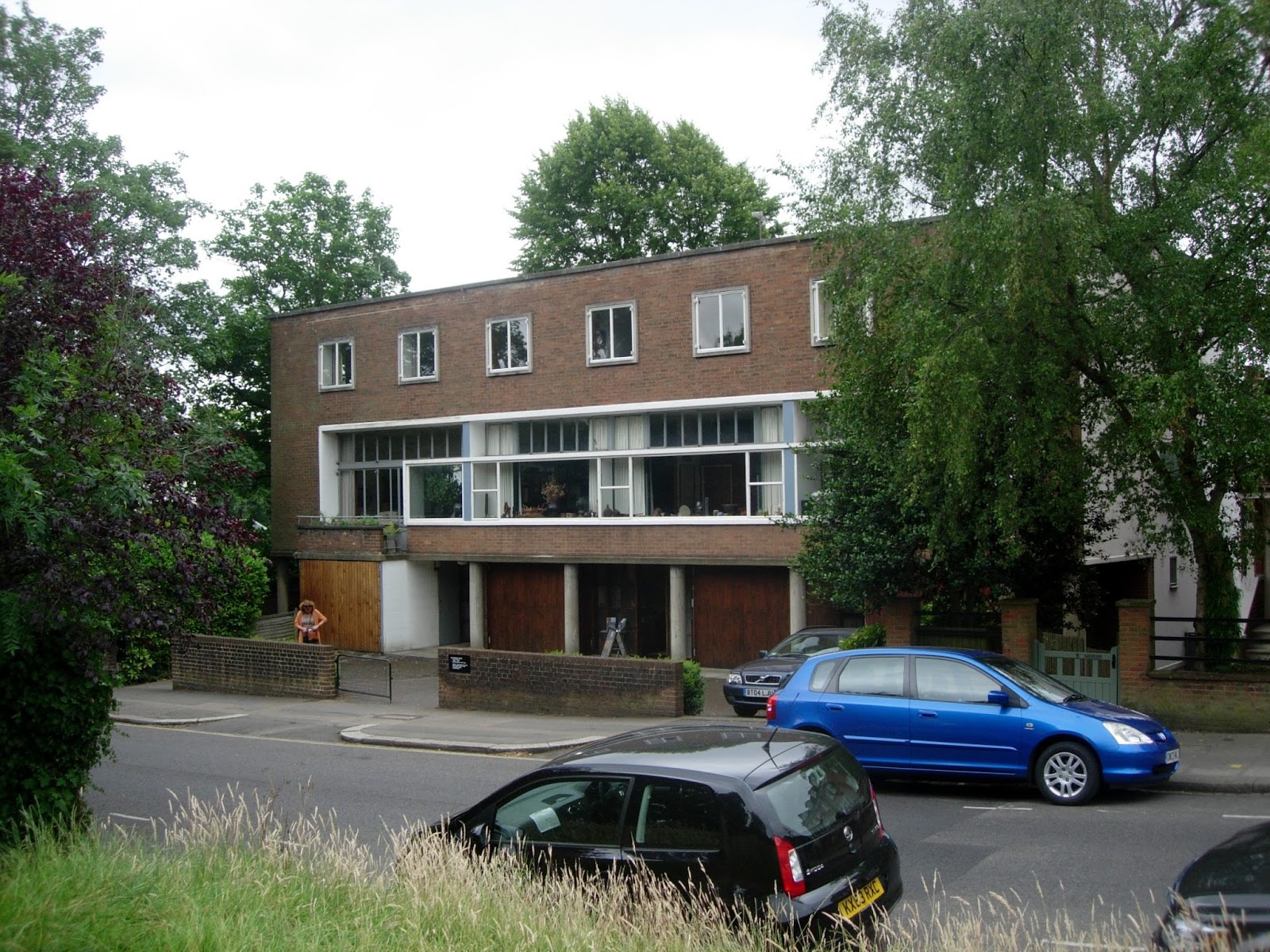


What is so interesting is that it looks so tame now. The concrete beams, the huge windows, the columns are all quite normal today.

That wasn't the case in the England of the 1930's - wealthy people's houses pretended to be oak beamed medieval mansions while the poor lived in dark, unhealthy slums.

Light, air, space?


That was something alien, something unheard of.

Now it's normal for schools, hospitals, stations, offices and even homes to be light and airy.

Then we drove down to Belsize park which is at the bottom end of Hampstead;


I was there to take a look at 'The Lawn Road Flats', an incredible social experiment which has been recently renovated. Even better, there is now a free gallery which explains the history of the flats and exhibits the furniture and style of the building.

It's fantastic;


Financed by the Pritchards, designed by Wells Coates, it was intended to follow the principles of Modernism, the ethos of Le Corbusier and, as Wells Coates said;

"I can plan a house - a machine to live in - which will give you better accommodation than that provided by the present plan".

He was as good as his word and just look at these fantastic lines;


It's pure sculpture.

The flats were small and designed with tiny kitchens - there was a communal kitchen and all services were supplied to the residents.

More than that, the Pritchards company 'Isokon' made furniture for the flats too, in the 'International Modern style'.

One of the first residents was Walter Gropius, the exiled director of 'The Bauhaus' college in Germany, which had pioneered the use of radical new materials like glass, steel, and plywood. Naturally, Isokon reflected this; 


They made revolutionary stacking chairs and chairs made out of tubular steel and leather;


But the star of the show is still the building, which just dominates everything;


 The 34 flats were in great demand and at different times were occupied by the leading lights of the modernist movement like the sculptors Barbara Hepworth and Henry Moore, the abstract painters Ben Nicholson and Piet Mondrian, Agatha Christie the author as well as a changing collection of writers, journalists as well as a few ordinary people.
 
It was fashionable and to be honest, quite expensive.
 
There was even a smattering of Soviet spies to enliven the atmosphere!
 
But the real star is always the building;


What I found so strange, just like with Willow Road, is that looking at these two buildings with the eyes of 2015...they look quite normal and natural just like the furniture which once seemed so revolutionary.
 
On my way home, I stopped to take a photo or two of an office where I once worked which has now been turned into expensive flats.
 
Built in the 1960's you would call it boring, everyday. And yet the architect had appropriated many of the ideas from the Lawn Road flats or Willow Road that had seemed so outrageous some 30 years before.
 
If you are in the area, take a look. Lawn Road is looked after by volunteers every Saturday and Sunday and is free - paid for by a stellar list of sponsors from the world of design and architecture.
 
2 Willow road is owned by the National Trust and costs £6 to go around.
 
Neil Harris
(a don't stop till you drop production)


Wednesday, 15 July 2015

Old Hampstead Village.

I'd been feeling ill all last week and as a result we didn't do anything much - by Sunday we had to get out of the house.
 
So we drove up to London for the day - I know the city reasonably well and if you get there early enough on a Sunday morning when it's quiet, you can park in the most unlikely places for nothing.
 
It's been a few years now, but I used to go up to Hampstead about four times a year - I helped out at second hand book sales to raise money for 'The Morning Star', Britain's still surviving, left wing daily paper.
 
To my amazement, I was even able to park in my old place, right in the middle of Hampstead. Who'd have guessed?
 
Even more surprising, the community centre we used was open, newly painted and looking good;


There was even a book sale going on but it was new books this time;


Hampstead is a little old village on the top of a hill looking down on London Town. It grew up because it was the first coaching stop after you left the city - it used to take a horse drawn carriage a couple of hours to get there. I'm guessing most of that time was getting up the steep hill from Camden.... it's not really that far.

Then someone discovered some springs on the top of the heath and it turned into a fashionable spa for a while although it soon declined.

So there are little alleyways and old buildings;


There are some very expensive shops and some rather expensive houses too - this area has the largest concentration of millionaires in the country;

I love this old advertisement;


It reads; " Established 1746 Chas B King, Estate Agent, Decorator, Gas, Hot Water and Sanitary Engineer". Mr King was pretty determined to make himself a living one way or another.

We walked all around the 'village', up and down the little alleyways and ended up at Hampstead Square, London's smallest. You can't see it from here, it's just in front of the church, where we had our lunch;


As we walked back down the hill I saw these two old bollards;


I don't think they are original cannons but they are in the style of the first ever bollards.

After the Napoleonic wars, Britain had captured a lot of French cannons. This was really bad news for the foundries that made our cannons - they were all facing bankruptcy.

So, they lobbied the government hard (I guess money may have changed hands) and in the end the captured cannons were buried in pavements to protect pedestrians instead of being used for war. They used to weld an old cannon ball on top of the cannon as an ornament. When they ran out of cannon, the design carried on.

Here's the old 'lock up' jail;


It's built into the wall of the house where the magistrates used to hold their court; in 1730 they built a one cell jail to hold prisoners overnight.

We were heading down to Hampstead Heath which is a semi-wild park overlooking London.

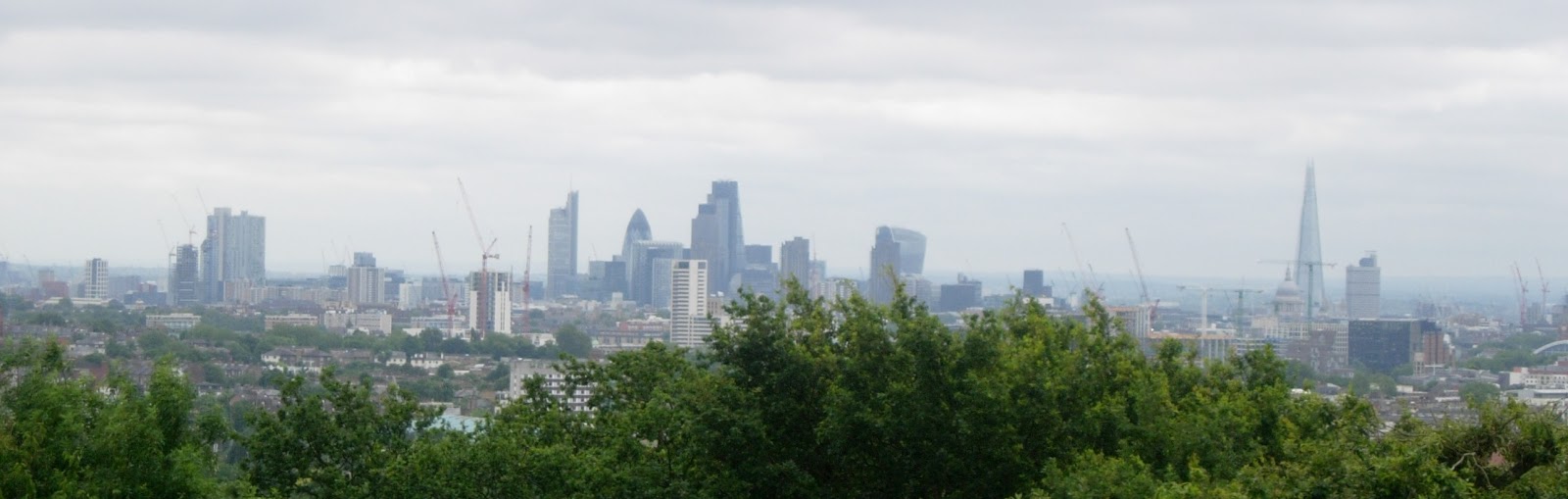
We crossed the ponds and walked up onto Parliament hill for the amazing view;


This was a favourite spot for Karl Marx and his family to come for picnics - with Friedrich Engels when he was down from Manchester for the weekend. The view has changed a lot since then - to be honest it's changed a lot in the last 10 years too.

At the bottom of the hill there were stalls and exhibitions about the heath;


Including some rare newts from the ponds;


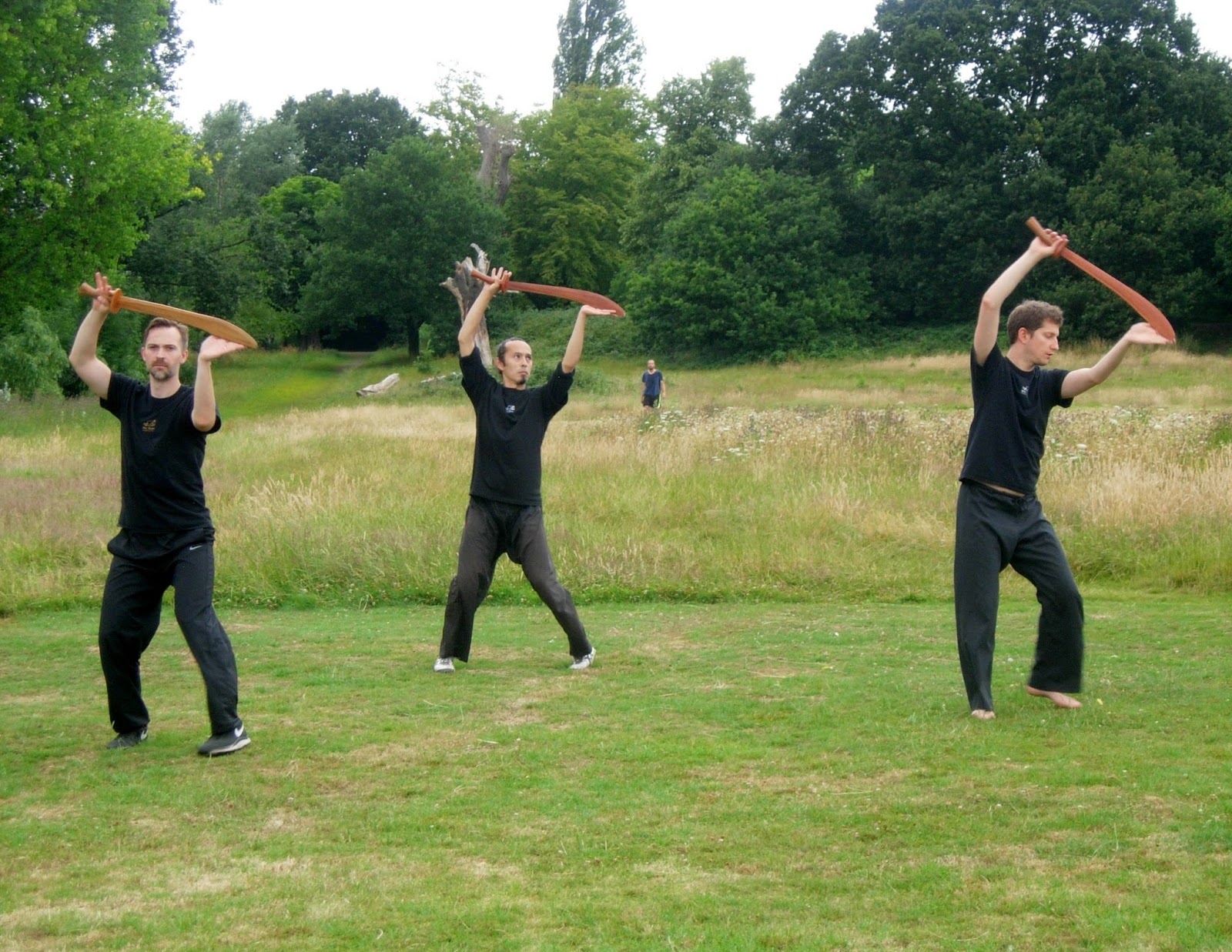
And Tai Chi;


Which is actually a martial art;


I liked this sign on the Camden Peace garden;


But how about this house right at the top of Hampstead village? I bet you can't guess it's story;


It's called (a bit sarcastically) 'The Admiral's House' and was built in 1700 by a naval lieutenant who had had unfulfilled dreams of becoming an Admiral. When he retired he built his house with a ships quarterdeck on the roof from which he used to fire a cannon every so often.


And that was the inspiration for Hampstead resident and author, P.L.Travers to create her eccentric character 'Admiral Boom', who used to fire off a cannon from the roof of his house every hour in........'Mary Poppins'.

This has been a quick tour of 'old' Hampstead - tomorrow I'll show you a bit of 'Modern' Hampstead......you'll really like that.

Neil Harris

(a don't stop till you drop production)

Home: helpmesortoutstpeters.blogspot.com

Contact me: neilwithpromisestokeep@gmail.com